




14views
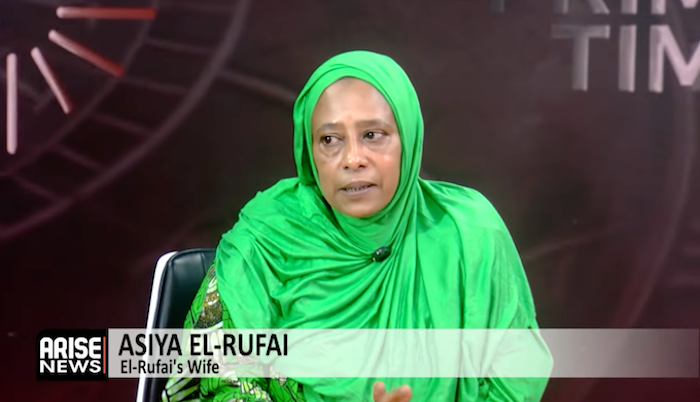
The wife of former Kaduna State Governor, Nasir El-Rufai, Asiya El-Rufai, has appealed to President Bola Tinubu to ensure her husband enjoys his constitutional rights as he faces trial over allegations of unlawfully intercepting the telephone communications of National Security Adviser, Nuhu Ribadu.
Speaking during an interview with ARISE NEWS on Wednesday, the lawyer said the family was not asking the President to interfere with the criminal proceedings but to ensure El-Rufai receives fair treatment in line with the law.
According to her, the former governor should be granted access to adequate medical care, legal representation, family visits and bail on reasonable terms where applicable.
Her appeal comes amid controversy surrounding El-Rufai’s prosecution, including concerns over his health in custody and claims that restrictions imposed on him have hampered his ability to prepare his defence.
Asiya said the charges against her husband are bailable under Nigerian law, noting that repeated applications for bail had either been rejected or granted under conditions she described as impractical.
She explained that while the Federal High Court in Kaduna granted bail requiring two sureties with properties worth N200 million each in Kaduna’s Government Reserved Area (GRA), the additional requirement for attestation from the Kaduna State Traditional Council made compliance impossible.
“We’re appealing to the President just to allow the law to take its course, give him a fair hearing and let the courts be the arbiters,” she said.
The lawyer questioned why El-Rufai continued to be denied bail despite honouring previous court proceedings after being granted administrative bail by the Economic and Financial Crimes Commission (EFCC).
She also suggested that political considerations could be influencing the case, while stopping short of accusing the judiciary directly.
“I don’t want to speculate, but there must be some politics going on. The prosecuting agencies are the ones opposing his bail and portraying him as a flight risk,” she stated.
On her husband’s health, Asiya disclosed that authorities had allowed El-Rufai to visit eye specialists for treatment related to glaucoma but were preventing him from seeing his long-time personal physician.
She criticised the arrest of the doctor, Professor Bello, describing him as El-Rufai’s physician since his tenure as Director-General of the Bureau of Public Enterprises (BPE).
Expressing concern over the development, she warned that targeting medical professionals for treating politically exposed persons could discourage doctors from offering independent medical opinions and further worsen the country’s brain drain.
Asiya also dismissed allegations that El-Rufai used a hospital visit to hold political meetings, insisting the visit was solely for medical treatment as permitted by the court.
She explained that any interactions with members of the public occurred in an open hospital reception and were not pre-arranged.
While reiterating that President Tinubu should not halt the trial, she recalled her family’s support for his 2023 presidential campaign, saying they expected only fairness and respect for due process.
According to her, although the President may not have the authority to stop the prosecution, he has the responsibility to ensure relevant agencies act within the law.
She urged Tinubu to strengthen public confidence in the justice system by ensuring equality before the law and adherence to due process.
“It’s not about El-Rufai alone. If people lose faith in the rule of law, anarchy becomes the alternative. Nigerians deserve confidence that everyone will receive fairness regardless of status,” she said.
Responding to claims that her husband is regarded as a political threat, Asiya questioned why political competition should be feared in a democratic system.
She argued that democracy should allow political opponents to compete freely rather than face intimidation, insisting that El-Rufai should be allowed to defend himself under a fair and transparent judicial process.
add a comment